Highlights
New Works Presentations
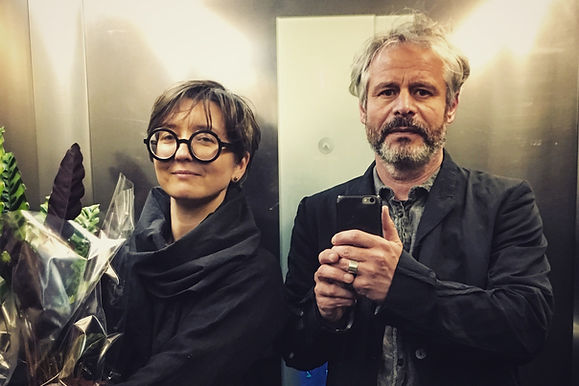
Anna Hayat & Slava Pirsky
Gyotaku prints
The artists create series of the Gyotaku prints in tribute to Japanese culture

The series operates in a delicate space between homage and transformation. Anna Hayat and Slava Pirsky do not simply imitate the Japanese tradition of gyotaku — they reactivate it through a contemporary photographic and conceptual sensibility. The works preserve the tectonic clarity and meditative restraint associated with Japanese aesthetics, while subtle interventions destabilize the image and open it toward new interpretations.
At first glance, the prints appear almost archaeological: fish, oysters, and shells emerge from softly textured paper surfaces like preserved traces or cultural relics. The wrinkled paper, muted earthy tones, and restrained monochrome palette evoke fragility, age, and material memory. Gold leaf functions not merely as decoration but as both a spatial and symbolic interruption. It introduces a sacred or ceremonial dimension, recalling byobu screens, kintsugi, and the luminous surfaces of traditional Japanese painting, while simultaneously transforming the marine subjects into icons suspended between nature and culture.


Particularly compelling is the artists’ treatment of language. Instead of traditional Japanese calligraphy, they construct simulated textual structures from repetitive microscopic marks resembling grains, seeds, or cereal-like particles. These pseudo-script systems hover between writing and abstraction. They imply meaning without fixing it. The viewer instinctively attempts to read them, yet the text remains inaccessible, unresolved, and open-ended. In this way, the works resist narrative closure and allow viewers to project personal associations, memories, and imagined stories into the composition.
This tension between legibility and opacity gives the series much of its conceptual force. The works evoke the authority of archival notation, scientific taxonomy, or sacred inscription, yet ultimately refuse translation. Meaning becomes atmospheric rather than informational. The “text” functions less as communication than as rhythm, texture, or visual breathing within the composition.

The fish themselves are treated with unusual sensitivity. They are not presented as trophies or purely natural specimens. Their isolated presence against expansive empty grounds produces a sense of suspension and vulnerability. Some appear almost transcendent, while others seem caught between life and disappearance. Enlarged eyes, sharp fins, and subtle distortions introduced through the printing process give the creatures an uncanny emotional presence.
The oyster compositions are particularly notable in this regard. Arranged in circular formations, the shells begin to resemble ritual diagrams, floral mandalas, or cosmic structures rather than marine life. Here, the artists move further away from documentary representation toward symbolic construction, while still maintaining the tactile immediacy of the gyotaku imprint.
Importantly, the series does not approach Japanese culture through exoticism or superficial quotation. Rather, Hayat and Pirsky engage with underlying aesthetic principles: asymmetry, emptiness, restraint, material sensitivity, and the coexistence of permanence and impermanence. Their works acknowledge tradition while allowing ambiguity, disruption, and hybrid visual language to enter the surface.


As photographers working through imprint, trace, and reproduction, the artists also bring a distinctly photographic awareness to gyotaku itself. The prints become records of contact, physical encounters between body, material, ink, paper, and time. In this sense, the series exists between photography, printmaking, and object-based meditation.
The result is a body of work that feels simultaneously ancient and contemporary: contemplative yet conceptually unstable, formally restrained yet emotionally charged.